Over the past weeks I find myself repeatedly saying phrases like “Roman Polanski made some good movies”. In conversations, we keep covering brilliant ideas from people who’ve done despicable actions or who’ve made great creative works and also advanced horrible thoughts.
I think it’s important to get the good from people and appreciate it. But you have to know that the man who helped America get to the Moon was a Nazi who worked people to brutal deaths. I believe I can fly is an incredibly good song. Jefferson, an architect of so many good thoughts, was a slavemaster, slaves built the White House and George Washington fought hard to recover the slaves that escaped him.
It’s uncomfortable, but you also need to know the full story. We need to talk about it. Because pretending the full story isn’t there is bad for us. Pretending the good isn’t there is also bad for us. And thinking people are only one thing is a fundamentally bad idea.
I love CitiBike – being able to grab a bike whenever for a short trip is just magic.
And then I saw a video about Bike Angels, and it grabbed me. It’s genius.
CitiBike has a clumping problem. Bikes flow like tides across the city, and they clump in popular destinations. Some docks end up with lots of bikes and some end up with very few.
They already have some overhead – the electric bikes need someone to come out and swap fresh batteries for dead ones. Repairs need to happen. They also have vans that pull up to overweight docks and transport them over to underweight docks. That’s not great though, using a motor vehicle to move bikes around. Better if people just did it cheaper on the bikes themselves.
That’s the bike angel program. It gives you points for moving bikes from crowded docks to emptier ones. More extreme docks give you more points. Doing it a lot is a streak and racks up your points. It’s all very silly and the very base rate of it all has a point worth around a dime. But it’s enough to make me OK with walking a little farther when I’ve got the time and riding a little farther to drop off at a dock that needs it.
And then I got a streak. And then I got to triple points. And then I found myself taking a ride between two docks to just not break my streak.
Recipes have a real problem on the internet. Everyone wants to share them, everyone wants to know them. But recipes are hard to monetize. They are not copyrightable!
They need places to put advertisements which they use to fund their writing
They think Google ranks recipes with stories higher
They actually want to share interesting information. They are excited and want to share what they know, not just edit a recipe for you, a stranger!
It’s similar to how youtubers shoot ten minute videos where they mention the sponsor in the first 40 seconds, then talk about how they will give you some information but first… They are serfs, sharecroppers doing what the lords of the internet have dictated is needed to get a buck.
But I really just want to keep and use the recipes themselves. As damage appears, we figure ways to route around it. My new favorite example is http://cooked.wiki – it’s a way to collect recipes and edit them. I’m building a little cookbook of my fave recipes there under my cooked.wiki profile.
The killer feature of cooked is not just the user interface, it’s the recipe importer. Find any recipe you like online that you’d like to use.
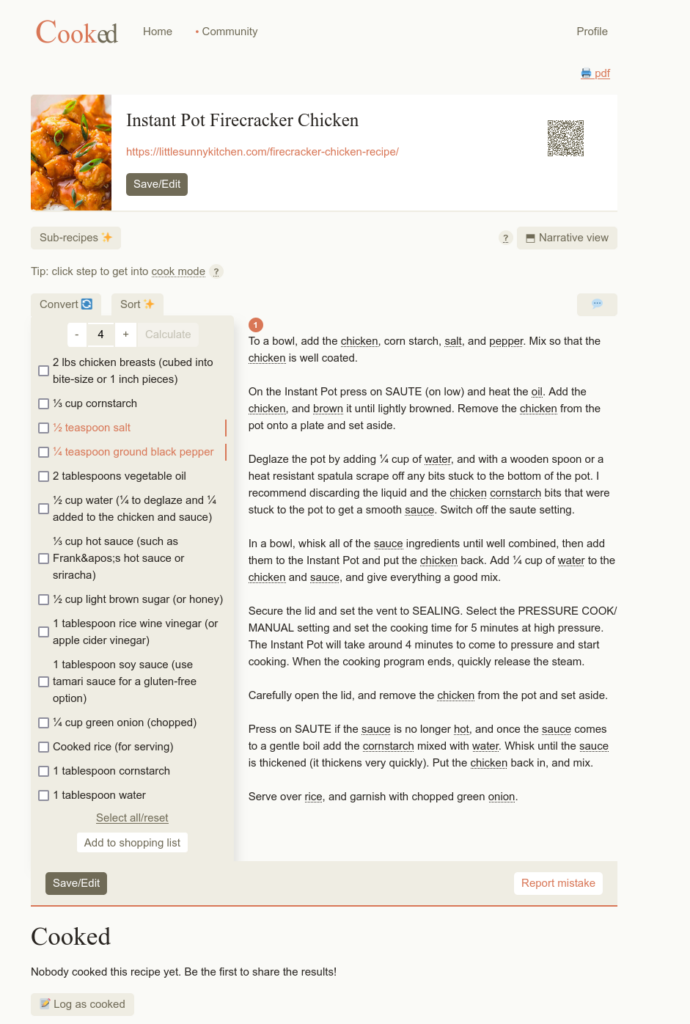
For example – I made this Instant Pot Firecracker Chicken recipe. It’s great because you can prep everything ahead of time, freeze it and cook it on a night when you are busy and don’t have lots of time. It’s pretty good for that kind of freezer bag meal! Here’s a screenshot of the page, I’ll see you at the bottom of that.
So that’s a LOT. But I just go to the url bar and add http://cooked.wiki at the front of the url like so:
And that turns into something SUPER easy to read, super small that I can save in my personal recipe book.
It’s SO user focused. Any step you click on highlights the ingredients needed – it auto scales your portion sizes and you can create a shopping list from the recipes you are going to cook.
I can only assume that at some point this will get bought by a private equity firm and plundered. Until then, I’m using it and hoping they let me pay for the privilege.
I just published how I was avoiding “dumbscrolling” and was uh… looking at Mastodon and found an article about it!
My work writes big SAAS tools. These are tools that almost make no sense for one business to write to the highest levels of quality unless they are going to sell them.
The other end of software is the business of solving specific problems for specific people – and that’s the part that I really like. My part of the big SAAS business tends to be very focused on people trying to solve problems.
I love the perspective of this page about Home Cooked Software and Barefoot Developers. All the tools and practices are fundamentally about helping people solve the problems they care about and helping them find more interesting problems to work on.
these visions are not pre-programmed encounters but other players connected to you via the internet, and they have already played through the same events. Think of this as an asynchronous multiplayer system like ghosts in Elden Ring, only here they tangibly affect your game, perhaps leaving a key item such as a knife to plunge into said, unsuspecting kingpin.
You only ever follow in the footsteps of one player at a time, getting to know them through their decision-making impulses.
It’s a very apt mechanism for a game about the climate crisis, where collective action problems abound.
For all the whiz-bang novelty of this component, the lead designer maintains that it speaks to the game’s deeper themes – indeed, that the mechanic doubles as a carefully considered metaphor. After all, what is navigating the all-enveloping climate crisis, and perhaps even mitigating its worst effects, but a gargantuan collaborative effort involving people spread across vast continents?
This is another post my work asked me to opine on. I’m a big fan of developers that aren’t focused totally on making software – folks who make their own tools to solve their problems. However, it’s definitely possible to get yourself into a real pickle where you can build yourself into a corner you don’t have the time and skills to get yourself out of.
Pitfalls of the Ops Developer is about how to recognize when your group wants to transition from home-grown solutions to something more standard. It’s HARD to know and it’s hard to anticipate when you are about to hit one of those inflection points. As always, there’s a ton left out, but I love hearing from folks about their stories around the topic. I was just talking to a client in London and they brought this one up as being helpful and describing exactly the place where they are right now. Soooo… I thought I’d share it with you!
After hearing from both my Mom and a friend at AWS that they found this article really helpful in thinking about the topic, I thought I’d share it more.
It’s intentionally a short article and there’s a TON left out. For example, even if a robot can’t do your job well, that doesn’t mean your job won’t try to replace you with one – and you can’t wait to eat while they figure out they need a person in the loop.
Listen, I understand that people believe I exist in an endless state of incandescent rage, but they are going to have to invent new words for how angry I am about Glassdoor adding real names without users’ consent.
Eva halperin, EFF Director of Cybersecurity – https://hachyderm.io/@evacide/112125381301913499
I support salary transparency and forums for publishing information good or bad about workplaces, but these places need strong guarantees of privacy. Consent is critical.
I went to delete my account, but was surprised to see a full page pop-up about some new feature called a Community. I couldn’t click anywhere to close my account without completing the process to onboard to a new feature!
I just got a new phone. I held off as long as possible because it just seemed wasteful when the old phone worked fine. It seems like the network support for sub-5G phones is decreasing though – and that impacts my experience.
My old phone was old enough that it didn’t support eSIM, which I discovered was a problem when I was in London buying a short term plan.
So when I got an error while trying to activate newPhone, I had an inkling this was probably the issue.
I opened a support chat with this info “I have oldPhone, which doesn’t support eSIM, and I suspect that’s preventing activation of newPhone” – but with more details.
Friends, it took 40 minutes of troubleshooting to come to a conclusion, and yes, that was it.
I was frustrated. My experience has been that trying to steer just slows down the process through the support tree. And so it feels helpless. I can’t get them to do the thing faster and so I have to sit.
I am empathetic though – following the support tree is required for the job, and they won’t get fired for following it. I sense that they, too, feel helpless- they cannot take a short cut.
Of course this lends itself to being a position that is automated away, since there is little benefit to having a human typing the words they don’t come up with.
And at the end of the, of course, they tried to sell me insurance.