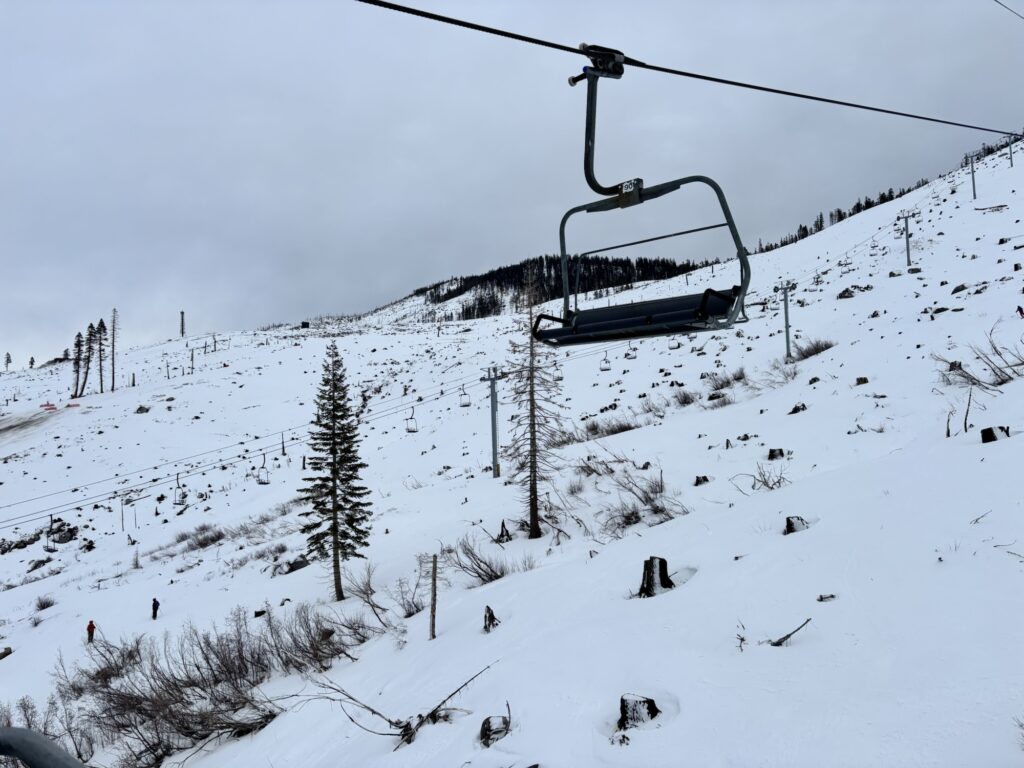
This is one of the weirdest little ski mountains I’ve visited. The approach is foreboding. There was a great forest fire that nearly burned down the whole place. They used snowmaking equipment to save their infrastructure. Now, you approach on a windy road through a forest of burnt trees.
The terrain was lightly covered, not too much snowfall. There was a 48″ summit snowpack, but lots of places on and off piste had very light cover.
The terrain is pretty interesting. Since the forest fire, they’ve had to log and remove the dead burn trees away, yielding a desolate landscape of stumps and rocks. You ride through ghost-glades of trees that used to be there. There are real chutes and cliffs, some rideable, none I trusted given the strange conditions. The snow was heavy and wet, so I found I had to unstrap in lots of places to get around. At the base of some of the ghost-glades we found ourselves going over huge rollers that you also couldn’t trust, since a few were bottomed out into sticks and stones.
Once, we dodged through living trees to get into an interesting area and… it was just enormous boulders covered in snow – almost impassable.
This is one of the weirdest mountains I’ve been on. An ecological tragedy has yielded a unique experience – fun in a wasteland, more challenge than expected and in ways we aren’t used to. A real stretch. It was not the fun I might have been looking for, but it was exhilarating and provoking. Everyone we talked to that was local knew about the fire and was rooting for Sierra-at-Tahoe. They talked about how they bought tickets there or joined Ikon pass to make sure that Sierra-at-Tahoe didn’t go out of business, a little support to help it bounce back.
It’s a day with a good idea, based on a bad story. I’m going to take the good idea – practicing gratitude and not celebrate the bad story.
I have SO MUCH to be grateful for. My family is healthy, faces struggles and difficulty with patience and practice and we have enough to give back. We have growth and navigate trouble together – and while we’ve had plenty of trouble to navigate, none of it has drowned us.
My workplace is appreciative of what I do, not abusive, and has a fairly healthy relationship with me. More to come on this, but my main challenges are prioritizing the interesting problems to solve and navigating change.
My personal health is a bounty. I hope for my friends with difficulties life threatening and chronic. I am merely stuck with the realization that I won’t achieve my goal to do 2 one-arm pullups by the end of the year. But I’m so close I think I’ll have it by the end of next year. It took me multiple years to be able to do a pistol squat, but I got there as well.
I’m grateful to have found some of the most wonderful interesting people and to have them be my friends. I’m still a little incredulous that they tolerate my personality, my long silent periods, but show me the same love and joy when we find each other together. They shore me up where I’m weak and I’m grateful when I can similarly help them.
I’m thankful that people are resolving to cooperate locally, support their communities and help each other get through coming tough times. The bonds forged in adversity can be strong and I hope they will link us in better times as well. I’m hoping to do more direct help by feeding hungry people at CHiPS and find more ways to be personally involved.
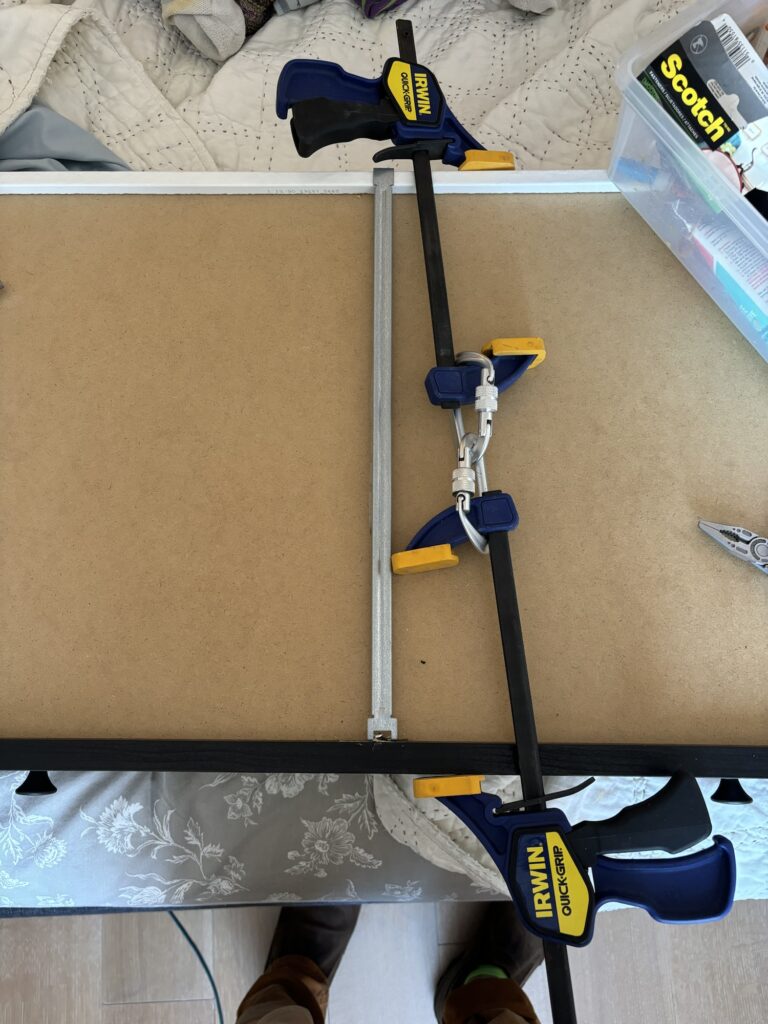
If you’ve only got two clamps because you live in an apartment – you can hack them into any length you need.
I really liked riding an e-bike – but I found it hard not to crank up the motor all the time and go super fast!
Trouble started for me when the spokes started giving out on the wheels. I got them repaired on the front wheel. Then I noticed some broken on the back wheel. I went to my local bike shop, Habitat Bicycles, and they said they couldn’t repair it because too many spokes were broken and they didn’t work with these kinds of e-bikes.
Hell! I had to get it repaired! I bought a replacement wheel for a few hundred dollars. Then I took it to a shady repair shop to move the motor over from one wheel to another. It was not a good job. The motor didn’t properly engaged. Then I went to London for a while and when I came back the battery stopped taking a charge.
So, for months I’ve been riding what is basically a very heavy non electric bike. That’s fine! I have strong legs. Then the rear shimano shifter dropped a spring while riding so now I have a 3 gear heavy regular bike.
I’m not very happy with this, though I’m generally really happy riding a bike. I don’t want to pour more money into fixing more things on this bike.
I just discovered that my work has a health reimbursement for bicycles!
So I’m finally going to buy a nice bike. I’ve never had a nice bike. I’ve always been proud of making do with old bikes and making them last forever. When I got hit by a car in South Carolina, I got the fork re-straightened and kept riding that same bike for years longer.
But I really think I’ll get something out of a nice bike.
I had to decide – do I get an e-bike again?
I’m not getting an e-bike. I like pedaling, I like getting stronger. E-bikes aren’t serviceable everywhere and are complicated. My experience of getting someone else to take care of an e-bike was not very pleasant. E-bikes are really expensive. I have to remember to charge the battery. Many days I’d have the battery upstairs and realize I’d forgotten to bring it down when I was heading out.
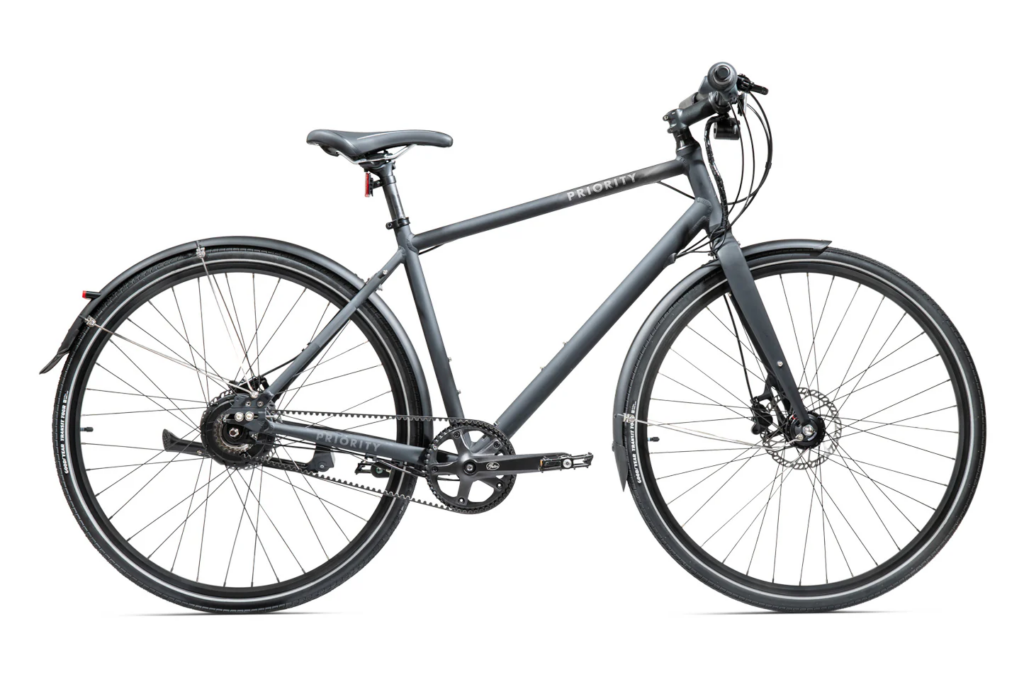
So what kind of bike? A commuter bike describes me perfectly. I’m a commuter. I read 8 miles or so to work and 8 miles back with a bridge in each ride.
The next big choice I made was to go with self-service simplicity or high tech offerings. If I get a bike with front and rear cassettes, a chain, and caliper breaks – that’s a machine I can service basically any part of. I’m also interested in what seem like good recent advances – continuous variable transmission internal hubs and belt drives, disc brakes and the like.
I decided to go against my usual self-service simplicity because I’ve noticed I don’t have the time. I just can’t be arsing around with my bike as much these days – so fixing it myself isn’t something I’m prioritizing.
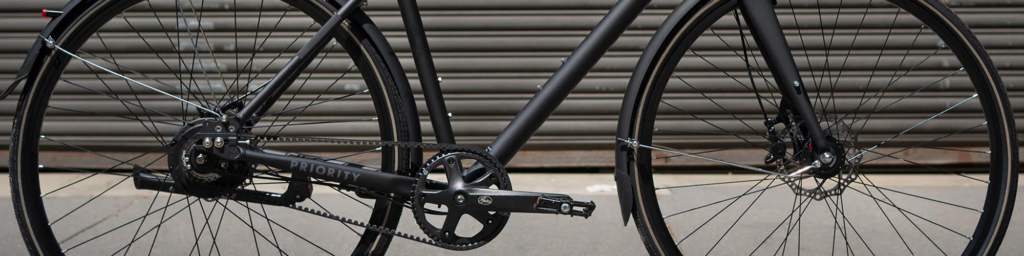
It’s got a carbon belt drive – no more grease stains on my pant legs when I forget to roll up.
Continuously variable transmission internal hub. I’ve tried this on Citi Bikes and it seems pretty sweet. An internal hub is also one less thing to maintain. It is sealed from the elements and should be fine unless things go seriously wrong – but then I’ll HAVE to take to a bike shop.
Dynamo powered front and rear lights. I like not having to take my light off to recharge it.
Hydraulic disc brakes should work in all conditions – but I won’t have the tools to fix them.
I’m eager to get my hands on it and decide if it’s right for me!
My buddy Frankie turned me onto Berbere spice on popcorn (it’s perfect). I got some from Sahadis before hanging out with the beer club boys and it sat on the shelf until this last week.
Some ribs came in our CSA, so I got excited to make a Berbere rub and sous vide the ribs. I was really sick and bored before, so this was a really fun little project and the sous vide turned out perfect ribs with a complex flavor. The berbere rub is just salt, sugars and berbere spice mix, so it’s great to toss on popcorn as well.
My new passion is pickling. I’m taking perfectly nice things and, because we have too many of them, I’m sticking them in vinegar, salt and sugar solutions.
Get out of my way, because I’m brining my onions. Now I have pickled onions at the ready for any emergency burritos. Here’s my pickled onion recipe on cooked.wiki
Duck your head in respect, because I’m pickling jalapenos. We messed up and got way more jalapenos than we can consume fast enough. Now we’re going hog wild with the vinegar and the jalapenos will last and be stuffed into every chili or recipe when we have time.
Recipes have a real problem on the internet. Everyone wants to share them, everyone wants to know them. But recipes are hard to monetize. They are not copyrightable!
They need places to put advertisements which they use to fund their writing
They think Google ranks recipes with stories higher
They actually want to share interesting information. They are excited and want to share what they know, not just edit a recipe for you, a stranger!
It’s similar to how youtubers shoot ten minute videos where they mention the sponsor in the first 40 seconds, then talk about how they will give you some information but first… They are serfs, sharecroppers doing what the lords of the internet have dictated is needed to get a buck.
But I really just want to keep and use the recipes themselves. As damage appears, we figure ways to route around it. My new favorite example is http://cooked.wiki – it’s a way to collect recipes and edit them. I’m building a little cookbook of my fave recipes there under my cooked.wiki profile.
The killer feature of cooked is not just the user interface, it’s the recipe importer. Find any recipe you like online that you’d like to use.
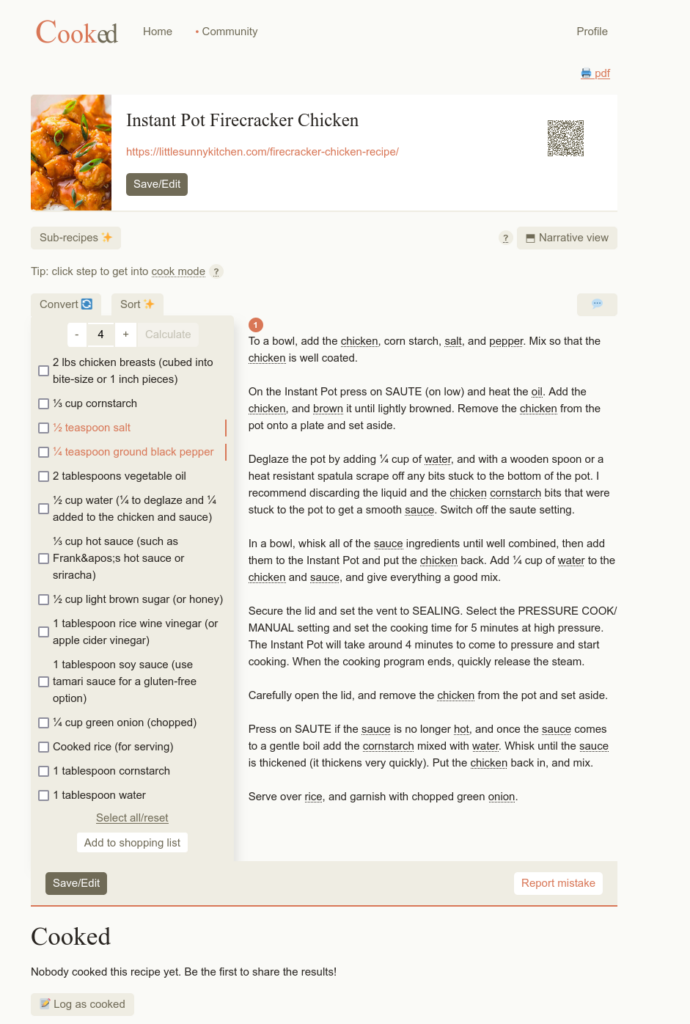
For example – I made this Instant Pot Firecracker Chicken recipe. It’s great because you can prep everything ahead of time, freeze it and cook it on a night when you are busy and don’t have lots of time. It’s pretty good for that kind of freezer bag meal! Here’s a screenshot of the page, I’ll see you at the bottom of that.
So that’s a LOT. But I just go to the url bar and add http://cooked.wiki at the front of the url like so:
And that turns into something SUPER easy to read, super small that I can save in my personal recipe book.
It’s SO user focused. Any step you click on highlights the ingredients needed – it auto scales your portion sizes and you can create a shopping list from the recipes you are going to cook.
I can only assume that at some point this will get bought by a private equity firm and plundered. Until then, I’m using it and hoping they let me pay for the privilege.
This is a bonkers Warhammer 40K / AI banger. It’s hard to watch and there is an interesting making of video. None of the other songs by this band seem to sound anything like this.
I just published how I was avoiding “dumbscrolling” and was uh… looking at Mastodon and found an article about it!
Like you, I enjoy small bursts of dopamine delivered at irregular, unpredictable intervals and I’ll do nearly anything to keep getting them.
This doesn’t often align with my long term or medium term goals.
I’m trying to be conscious of how I’m spending my time, so I noticed a while ago that I was on Youtube Shorts for… hours. Just scrolling and scrolling. Sometimes laughing. It’s not really doomscrolling, just… dumb. I’m on Youtube shorts because I’m too old for instagram or tiktok.
One of the best hacks I did around that was:
Enable Screentime on the iPhone
Set a limit of 1 hour for youtube
Forget my Screentime password
So now I get interrupted when I run out of time and have to go waste my life doing something else. I’m sure I could reset my screentime password and figure out how to get more, but this is just enough to stop me and get me to switch activities.
It also gives me a feeling that I don’t want to use up all my precious delicious time up early in the day, so I don’t zone out too long anyway.