All posts by MattK

About MattK

I like you.

Ditz – the distributed issue tracker

If you are using a distributed version control system 1 you get some really cool benefits and some really strange problems.

When I was toying around on a project with Aaron, I fell in love with ditz. We needed a quick way to keep track of bugs, without taking the time to set up a central bug repository. We wanted a bug tracker that could live in the same place as the code, where adding a friend to kick in on code didn’t require more accounts being set up and maintained.

Ditz did all of that, works straight from the command line, and even outputs some sweet html pages for display to the world.

Ditz is kind of abandonware right now as the original author has gone on to other things – but the state it is in right now is just perfect for my personal projects. If you are using it, I’ve added an RSS feed for the html output.

And the really good news? I just convinced the maintainer to make me a co-maintainer. So that means that I can integrate features! Once we get enough in for a new release, I’ll post an update right here!

  1. like git or darcs or mercurial, etc.   (back)

What to do when you get detached from your head, you git.

I found myself wandering about detached from my head, fully committed. You don’t want to commit when detached from head, but I had.

I didn’t know how it happened, but there I was, headless. What a silly, silly git.

I reached out to a friendly spider and the answer was there in the web.
Before you wander back to your head, it is important to mount yourself to a branch, then you can use that branch to reattach your head quite easily.
Here is how the magic incantations go:

git checkout -b the_wanderer
git rebase master
git checkout master
git merge the_wanderer
git commit

I’ve tied the branch to where I am, then grabbed where I was and attached that, then bound everything back together.
Clear as mud? Already done git checkout master? Check the spellbook that inspired me.

My Valentines / Music Hack Day NYC app!

-or-
Why I wasn’t around this weekend.

I was at NYC Music Hack Day!

You can try out the idea here in our valentune.es beta. We send love and music over wires and wireless to your special sweetheart.

You put in your sweetheart’s Name & cellphone, a couple of key words about your them and then ask the app to get busy.

It goes out to the MusixMatch lyrics service – finds lyrics that describe your sweetheart and then gives you a list of songs we can find streaming full mp3s online for. You choose what you don’t want in the play list and hit send.

We call your sweetheart up using the Twilio API , give them your sweet message and then play them your custom made mixtape over the phone! Yes, my lovely wife Sam was the first non-developer to get a call from the valentun.es robot.

Getting SongsPick songs on the iPhone!

Don’t have a web browser handy? Surely you jest! If you’ve got an iPhone you can use the iPhone app.

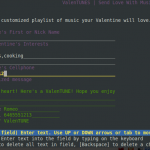
If not, the website is mobile compliant and works great on Android phones. The website uses CSS3 and WebFonts for style, but degrades well to older browsers. How old? IT WORKS ON LYNX!in case you need web 3.0 from a terminal

So all of this was accomplished by 6 talented and dedicated people over the course of 24 hours in NYC. The whole team was positive and awesome. I’m really proud of what we did so quickly. It’s got bugs 1 , but it works. I didn’t sleep the whole 24 hour hack session and I worked on a lot of the bits.

  • The Musixmatch call to find lyrics that talk about your sweetheart.
  • The Skreemr call to find playable songs with those lyrics
  • Adapting Jeff’s web mockups to Django templates
  • Calling into Alex’s Twilio wrapper
  • Pitching the idea and the vision and recruiting the group
  • Helping design the process flow and settling on using Django with Nate
  • Helping coordinate who would do what and figuring out the pitch with Jeff
  • Presenting the whole thing in 2 minutes to over 300 people with Anna and Nate

It was a busy 24 hours!

  1. the Title element has the wrong spelling of valentunes and the message doesn’t always go through and the songs sometimes take a long time to play, etc…   (back)

Book Review: “Where Good Ideas Come From” by Steven Johnson

Steven Johnson writes about great subjects. “Where Good Ideas Come From: The Natural History of Innovation” is a very good subject as it is about the patterns that underlie greatness.
Steven identifies a few key patterns that come up again and again with good ideas.

The adjacent possible – Good ideas are of their time, not ahead of their time. They are an extension of what is already around us. You see this in how great ideas seem to spring up from multiple people all at the same time in simultaneous invention. The example of a great idea failing because it is too far ahead of its time is Lord Babbage’s Analytical Engine – the idea was sound, but the technology of the world couldn’t put it into place.

The Liquid network. Ideas get better when they rub against each other – the reason so many good ideas come out of places like NYC and SF and the coffee houses of the renaissance isn’t that these places are magical or that the people there are smarter. People are talking to each other more in those places. There are more informal networks and ideas being passed back and forth among multiple disciplines.

The Slow Hunch: Sometimes ideas have to bake. We all applaud the dream that James Watson of the double helix structure of DNA. It fits our Romantic notion of great discovery happening as a flash of genius. The reality is that you need to study for ten years, immersing yourself in a subject, nursing along a hunch, before the flash of insight can come. You don’t know what is important until later, so it is important to keep track of those little hunches for later – revisiting them with new information can help them bear sudden fruit.

Now, the book contains more patterns, but the meat is all there in the first three. The idea of exaption is contained within the adjacent possible, serendipity and error are contained in the liquid network. What this book is good for – it contains some good description of the real history of ideas and idea making, dispels some of the romantic and disruptive myths of ideation, and prescribes a few practices that make good ideas more likely.

“If there is a single maxim that runs through this book’s arguments, it is that we are often better served by connecting ideas than we are by protecting them”

It is, as are most books these days, overlong. Brevity is still a good idea, but I think the market demands that books be a certain size.

Passwords – hard to do, important to get right.

Over on Staunchly Technical, Nate gives a rundown of his password scheme:

“Unique” memorized password: Google, Password manager(s), home server (exposed to Internet).

  • These are “master key” systems – if these are compromised then the hacker effectively has the ability to get my password to anything else. As a result, the password for these is not used on anything else (really, I ought to have a separate pw for each of these, but since they’re all so unrelated I’ve just got one for all 3).

Random stored individual passwords: All things potentially damaging (banks, brokerages, prosper, IRA, etc)

  • These are randomly generated 10-character passwords – they might get sniffed, but they’re not going to get hacked. These get saved in the Firefox password DB and are also in my password manager program (Keepass, for anyone who cares)

Work password: all things work-related

  • Everything I do at work requires me to change my password every 3 months – since I have trouble with multiple passwords anyway, I just set them all to the same thing. Only one of them can be accessed from outside the intranet anyway, and my VPN is protected by a keyfob.

Easy (but still relatively secure) non-changing password: social networks and anything else that can’t cost me money or too much heartache.

Useless password: sites that I really don’t care about and/or don’t trust.

Nate’s a really smart guy, so he wouldn’t be spending all this time thinking and writing about it unless it was important.  Why is he using so many different passwords?

What’s going on here

He’s segregating them into security zones.  The most important one is his email or his password system manager.  If someone gets the key to his email they can reset passwords to his bank or investment accounts and the password reset email goes where?  That’s right.

When Gawker’s poor security and  taunting of 4chan led to the usernames and passwords of every user being posted online, it was a very big deal.  Most people use the same username in many places – because they want a sense of identity and reputation that can follow them around.  Or maybe it’s just easier to remember.  That’s probably why most people use the same password everywhere.  Like their bank and gizmodo.  So those folks are having trouble.

Not Nate.  All they can do is post nasty comments on social networks under his name, and he can reset the password and get past that.

Also, not me.

My Suggestion

I tend not to use the same username on every website.  I register something using the site itself as a key.  So if my email is mk @ gmail.com (it isn’t) I would just use the gmail “name+” trick to register at lifehacker as mk+lifehacker@gmail.com. This lets you know who is selling your email address  or getting hacked into.

I manage my passwords differently, in a way you might use.  I use a passphrase and then I use select letters from the site to construct a unique password per site.  Like so:

My passphrase is a memorable poem or sentence. Let’s use the first two lines of Yeats’s The Second Coming

“Turning and turning in the widening gyre,The falcon cannot hear the falconer”

I take the first letter of every word to make my password: “TatitwgTfchtf”

That’s a big password and easy to remember!  But you want your password to be unique across many sites.  Let’s do that by pulling the site into it.

Lifehacker has 6 consonants and 4 vowels.  Let’s add those on to the end and the beginning: “6TatitwgTfchtf4”.  Even if someone gets your password and knows another account of yours, you have a unique password at the other account.  You could also put the first and last letter: “LTatitwgTfchtfR”.  Whatever you want to put a little extra randomness in the mix.

Want to see how strong your current favorite password is?  Go to the MicroSoft password checker and try it.

Practice good password safety – I don’t want to get emails from your account asking me to help split up your Nigerian fortune.

https://www.microsoft.com/protect/fraud/passwords/checker.aspx?WT.mc_id=Site_Link

Police bees will hunt rogue geneticists

GO FORTH MY BUZZING SPIES AND FIND THE HIPPIES

Regine has a lovely interview with Thomas Thwaites 1 about a future where the police hunt growers of hallucinogenic plants via special bees.

How did the pollen forensics researchers react to your project?

In general the reaction was that it was almost believable… which is the reaction you want for a futures project I think. A plant geneticist, (who’s ‘Crash Course in Synthetic Biology’ I later crashed) saw the project and said he’d thought about taking genes from the Marijuana plant and putting them into a tomato plant (being a respected scientist I’m sure he wasn’t saying he’d thought about ‘doing it’, just ‘about it’).

And this gem of what’s actually happening now to translate pollen to crime:

Are the police in the UK already using pollen forensics?

Yes, and its been pretty instrumental in several very high profile cases. There’s this lady called Pat Wiltshire who is the police’s go-to person for pollen forensics. She can look at a sample of pollen from clothes or whatever, and visualise the landscape it’s from – a filed of maze, with a river next to it, and an oak tree in the middle – or something like that. The impression I got about police work when I was interviewing James, and a detective, was that it’s really arduous. Pollen forensics would be one detail in many that would lead to cracking a case, and as importantly, proving it in court.

This high weirdness is definitely part of the adjacent possible, one of those strange futures that hasn’t happened, but should.

  1. He’s the guy who tried to make a toaster out of raw materials, start to finish   (back)

Project Idea: Conscience

This is just a sketch of an idea. Help me fill it out.

The elevator pitch

An angel on her shoulder

What if you could have an angel on your shoulder that helped you make purchases that reflected your values? We’d all like to vote with our dollars, but complicated corporate structures and global supply chains have made it difficult to keep track of who is doing what.
Continue reading Project Idea: Conscience